
DFW Home Prices Are Flat. Here Is What the Federal Data Actually Says for South Denton County Buyers and Sellers.
Quick answer: On August 25, 2026, the Federal Housing Finance Agency released its second quarter 2026 House Price Index. Home prices in the Dallas-Plano-Irving metropolitan division, which includes Denton County, were down 0.06 percent over the previous four quarters. The Fort Worth-Arlington-Grapevine division was up 0.33 percent. Nationally, prices rose 2.13 percent. In plain terms: Dallas Fort Worth home values held roughly flat over the past year while the rest of the country appreciated modestly. Prices did not crash, and they did not climb.
That single paragraph answers the question most people are typing into a search bar right now. The rest of this post explains what sits underneath the number, why almost every article you will read about it gets the geography wrong, and what a flat market changes about how you buy or sell here.
The numbers, straight from the source
These figures come from the FHFA House Price Index report for the period ended 2026 Q2, published August 25, 2026. All values reflect the purchase only index, seasonally adjusted and nominal.
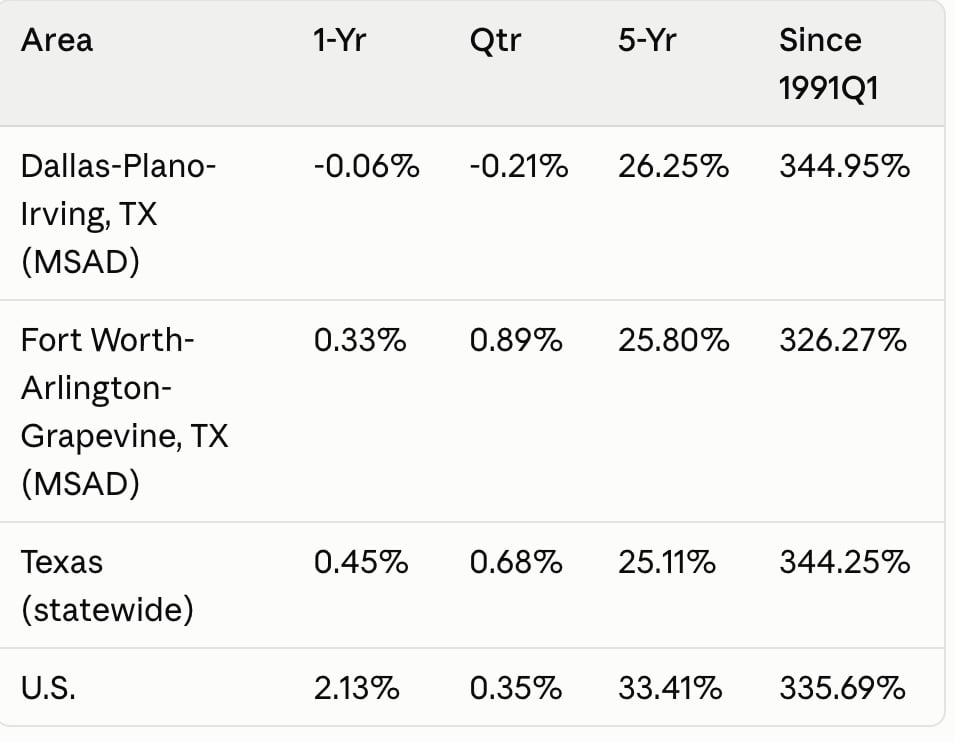
For context on the national spread in the same report, the strongest metro was Elgin, Illinois at 7.73 percent and the weakest was Everett, Washington at negative 3.73 percent. Prices rose in 76 of the 100 largest metropolitan areas and in 46 states plus the District of Columbia. Texas ranked 45th among the 50 states plus DC for one year appreciation.
Other Texas metros in the same report: Austin-Round Rock-San Marcos was down 0.27 percent, San Antonio-New Braunfels was down 3.04 percent, and Houston-Pasadena-The Woodlands was up 0.20 percent. Dallas Fort Worth was not an outlier. The entire state cooled together.
The part almost everyone gets wrong: there is no single DFW number
If you search for Dallas Fort Worth home price appreciation, you will find articles that quote one figure. The FHFA does not publish one figure for DFW in its quarterly metro table.
The Dallas-Fort Worth-Arlington metropolitan statistical area is large enough that the Office of Management and Budget splits it into two separate metropolitan divisions, and the FHFA reports each division on its own line:
- Dallas-Plano-Irving, TX covers Collin, Dallas, Denton, Ellis, Hunt, Kaufman, and Rockwall counties.
- Fort Worth-Arlington-Grapevine, TX covers the Tarrant County side, along with Johnson, Parker, and Wise counties.
If you live in Lantana, Argyle, Bartonville, Highland Village, Flower Mound, Corinth, Hickory Creek, or anywhere else in Denton County, your market sits in the Dallas-Plano-Irving division. That is the negative 0.06 percent line, not the positive 0.33 percent line.
That distinction matters more than a rounding difference suggests. It means the federal number attached to your county is the flatter of the two, and it means any article quoting a single blended DFW figure is quoting something the FHFA did not publish in that table.
One thing to watch going forward: the 2026 Q2 report notes that beginning with this release, the FHFA will publish quarterly indexes for 13 large statistical areas that are composed of divisions. Dallas-Fort Worth-Arlington is one of them. A true combined DFW series may now exist in the downloadable data files even though it did not appear in the printed metro table.
What a flat year means if you are buying
A market that moves less than one percent in twelve months behaves differently from one moving eight percent, and the difference is mostly about pressure.
Time to think is back. When appreciation runs high, waiting has a cost. At effectively zero appreciation across the division, the penalty for taking a week to make a decision is close to nothing. That does not mean the right house will wait for you. Individual properties in desirable pockets still move quickly. It means the market as a whole is no longer punishing deliberation.
The five year number is the one to keep in view. Dallas-Plano-Irving is up 26.25 percent over five years. A single flat year does not erase that, and it does not signal that it is reversing. What it signals is that the extraordinary run of 2020 through 2022 has fully normalized.
Averages hide the deals. A division wide index of negative 0.06 percent is the net of homes that appreciated and homes that lost value. Somewhere inside that average are sellers who priced ahead of the market in 2025, sat, and are now motivated. Finding those situations is the work. The index will never point you to them.
Do not confuse a flat index with a buyer's market everywhere. Inventory, days on market, and price reductions vary enormously between Lantana and Corinth, and between a 2,400 square foot home and a home above one million dollars. The federal number is a regional temperature reading, not a local diagnosis.
What a flat year means if you are selling
This is where the data gets uncomfortable, so here it is directly.
Appreciation is no longer doing any of your work. If you bought in 2024, the federal data suggests your home is worth roughly what you paid. If you are counting on two years of growth to cover your closing costs and your move, the math may not be there. Run it before you list, not after.
Pricing errors get expensive fast. In a market appreciating six percent a year, a listing priced five percent high eventually gets rescued by the market itself. In a market appreciating zero percent, it does not. It sits, accumulates days on market, and eventually sells for less than it would have if it had been priced correctly on day one. This is exactly why we built the Dynamic Pricing methodology, and it is why our listings have averaged roughly twelve days on market against a broader market average of forty to sixty.
Your neighbor's 2022 sale price is not a comp. The index is up 26 percent over five years and essentially unchanged over one. Both facts are true simultaneously. The relevant comparison is what sold in your specific neighborhood in the last ninety days.
Condition and presentation carry more weight now. When buyers are not racing anyone, they notice everything. In a flat market, the homes that sell at the top of their range are the ones that give a buyer nothing to negotiate against.
Why the FHFA number is not your home's value
This is the most important limitation in the entire report, and it is worth stating plainly.
The FHFA House Price Index is a repeat sales index. It measures average price changes by comparing multiple transactions on the same single family properties over time, which controls for changes in the mix of homes selling. The flagship index uses purchase transactions backed by conventional, conforming mortgages purchased or securitized by Fannie Mae and Freddie Mac.
That construction has three consequences for you:
- It excludes a lot of transactions. Cash sales and loans above the conforming limit are not in the flagship index. In a market with meaningful activity above one million dollars, that is a real gap.
- It is a metropolitan division average. Denton County is one of seven counties in the Dallas-Plano-Irving division. A number built from Dallas, Collin, Ellis, Hunt, Kaufman, and Rockwall alongside Denton tells you almost nothing about a specific street.
- It is a rate of change, not a price. The index tells you direction and magnitude. It does not tell you what your home would sell for.
We use this data as a macro reference point. We do not use it to price a listing, and no one should. Pricing requires comparable sales from your specific micro market, adjusted for condition, lot, and timing.
Frequently asked questions
Are home prices going down in Dallas Fort Worth? Not meaningfully. According to the FHFA data released August 25, 2026, the Dallas-Plano-Irving division was down 0.06 percent over the previous four quarters and down 0.21 percent for the quarter. Fort Worth-Arlington-Grapevine was up 0.33 percent for the year and up 0.89 percent for the quarter. These are flat readings, not declines in any practical sense.
Which metropolitan division is Denton County in? Denton County is part of the Dallas-Plano-Irving metropolitan division, along with Collin, Dallas, Ellis, Hunt, Kaufman, and Rockwall counties. This is confirmed by the Bureau of Labor Statistics, HUD, and the Texas Comptroller.
How much have DFW home prices risen over the last five years? The Dallas-Plano-Irving division is up 26.25 percent over five years and Fort Worth-Arlington-Grapevine is up 25.80 percent, compared with 33.41 percent nationally, per the FHFA index for the period ended 2026 Q2.
Is 2026 a good time to buy a home in North Texas? The federal data shows a market with very little upward pressure, which generally means more negotiating room and more time to make a decision than buyers had between 2020 and 2022. Whether it is a good time for you depends on your rate, your timeline, and how long you plan to hold. A flat market rewards buyers who are patient and specific rather than buyers who are simply fast.
Why is the FHFA number different from what my home is worth? The FHFA House Price Index is a regional rate of change built from repeat sales on conforming, conventional mortgages across a seven county area. It is not a valuation of any individual property and it excludes cash sales and loans above the conforming limit.
When is the next FHFA report released? The FHFA will publish 2026 Q3 quarterly data, along with September 2026 monthly data, on November 24, 2026. Monthly updates arrive on September 29 and October 27, 2026.
The takeaway
Dallas Fort Worth spent the last twelve months going sideways while the country moved up about two percent. That is not a crash and it is not a boom. It is a market that has finished normalizing and is now rewarding precision on both sides of the transaction.
For buyers, precision means knowing the specific neighborhood well enough to recognize a mispriced home when it appears. For sellers, precision means pricing correctly on day one, because the market is no longer going to bail out an optimistic list price.
If you want to know what your home is actually worth in your specific South Denton County neighborhood rather than across seven counties, that is a conversation worth having.
About the author
Heather Shimala is the founder of Reserve 76 Realty, a boutique brokerage in Lantana, Texas serving South Denton County and North DFW, including Argyle, Bartonville, Highland Village, Flower Mound, Corinth, and Hickory Creek. She is recognized by RealTrends Verified in the top 1.5 percent of agents nationally and the top 0.5 percent in Dallas Fort Worth, and is a certified real estate coach through the RYSE program.
Sources
- Federal Housing Finance Agency, House Price Index Quarterly Report, 2026 Q2 and June 2026, published August 25, 2026. https://www.fhfa.gov/reports/house-price-index/2026/Q2
- FHFA Top 100 Metro Area Rankings dashboard. https://www.fhfa.gov/data/dashboard/fhfa-hpi-top-100-metro-area-rankings
- U.S. Bureau of Labor Statistics, Dallas Fort Worth Area Employment, for metropolitan division county composition.
This article reflects data available as of August 27, 2026. Market conditions change. Reserve 76 Realty is an equal housing opportunity brokerage.


